


SDT PRE-CONFERENCE BUSINESS: Putting Motivational Systems into Practice!
Overview
Managers, leaders, sales professionals, marketers, coaches, consultants, and others are quite aware of the importance motivation can play on performance, team satisfaction, and the overall well-being of those in work environments. Heck, not only are these folks aware, they are often held accountable for “motivating” people to do whatever it is they must deliver.
Of course, motivation is much more difficult to manage. In fact, motivation itself is a more complex idea than just getting people to act.
First, there are different types of motivation. And those managers, leaders, coaches, et. al. can uniquely affect those different motivations. A manager might decide to inspire the team with a competition… but does it yield the outcomes she expected? Or, a leader may inspire a team to act, but it isn’t because of a shared purpose; rather, it’s because of fear. Alternatively, a coach might engage a client in a way that facilitates a passion for the work one does while aligning with the organizational objectives.
The trick is to know what can be done, the implications that might result from those actions, and then be intentional about what to do. That’s what this pre-conference program is all about. Putting core motivational psychology principles into practice. So…
How can we foster more intrinsically motivating (passion-based) environments that enable sustainable and passionate engagement?
How can we avoid those behaviors that do motivate, but in a way that undermines long-term and sustainable productivity and frustrates teams along the way?
And how do we put these systems and structures in place within the various contexts we work?
Ultimately, it is about aligning the needs of the organization with those of the individuals – specifically, the basic psychological needs (autonomy, competence, and relatedness) that underpin this entire conference!
Program
Location
PRE-CONFERENCES – MONDAY, JUNE 29
Campus Biotech Geneva
Address:
9 Chemin des Mines
CH-1202 Geneva, Switzerland
Website:
https://campusbiotech.ch
Five takeaways
A motivational audit tool to diagnose where autonomy, competence, and relatedness are being supported or undermined in your team or organization.
Concrete SDT-aligned manager behaviors (feedback scripts, expectation-setting language, coaching prompts) you can use immediately.
Templates and checklists for designing SDT-supportive systems, especially for hybrid work policies, performance processes, incentives, and workflow structures.
A decision framework for “wicked problems” like burnout, turnover, poorly designed incentives, and hybrid-work friction.
A shared, science-based vocabulary for motivation that leaders can use to align teams, communicate expectations, and shape culture.
Target audience
The pre-conference is for leaders, managers, HR professionals, learning & development, coaches, performance consultants, and all those involved in the design of work environments.
Program goal
Our program goal is to provide the motivational tools, resources, and methods to enable organizations to overcome the biggest problems they face daily. Whether it is burnout, hybrid work, pay & comp, mergers, pandemics, or other factors that impede just getting the work done, we will explore how SELF-DETERMINATION THEORY (SDT) can provide solutions to all these wicked problems.
How it works
Formulated like a conference itself, we will offer 14 sessions addressing common but often overwhelming conundrums. General sessions include:
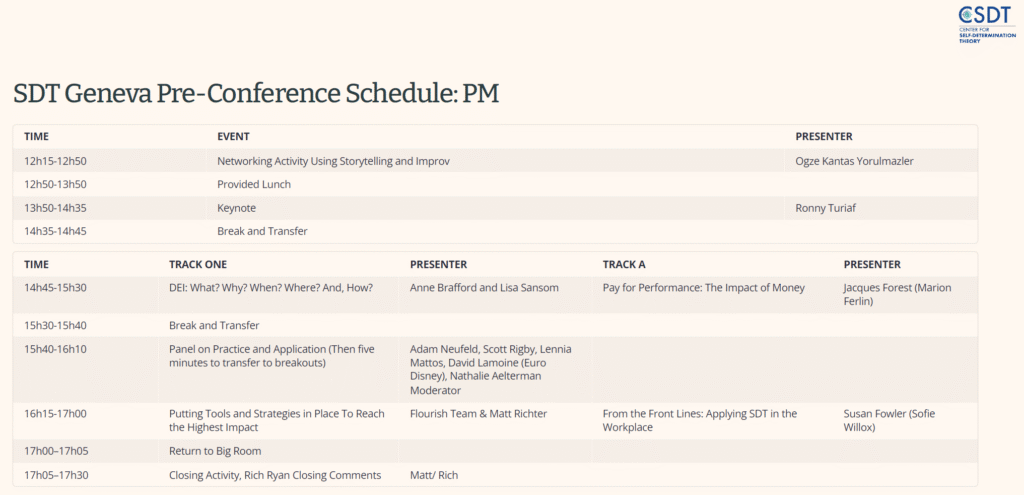
Jacques Forest, who will provide an opening keynote with an overview of SDT in organizations. In it, Jacques will present the value proposition for using an SDT-Values-Driven strategy and approach.
Former NBA Champion, Ronny Turiaf, who will give a keynote sharing what he has learned about the effects of SDT-supported and unsupported practices on winning and well-being.
A panel of those in the organizational trenches sharing best practices and applications for overcoming those wicked problems.
A networking activity so folks can meet and learn a bit about each other.
A storytelling and improv theater activity to explore viscerally how to engage your teams back home.
Closing comments from SDT Co-Creator, Richard M. Ryan.
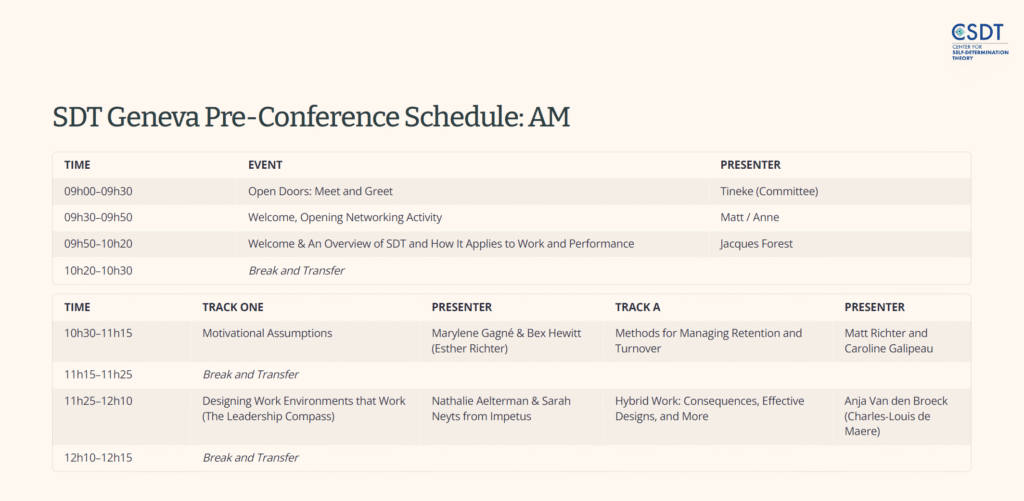
We will also have two tracks of concurrent sessions you can follow. Each 45-minute workshop is structured to interactively give you an idea, a tool, and an approach to solve a problem.
TRACK ONE: Big Picture & Organizational Strategy
Track One focuses on the big picture. It is all about the organizational culture, work design, talent management, and larger-scale strategies one can utilize.
Motivational Assumptions. What are the motivational assumptions we make, and how can we design work environments more effectively, according to what the science says? In other words, what myths and misconceptions are out there impacting the way we design work?
Designing Effective Work Environments. Taking the ideas from the first session, we go a bit deeper into how to design effective work. We will look at diagnosing issues and identifying processes and procedures we can implement.
DEI: What? Why? When? Where? And, How? How does DEI play a significant role in the workplace, and how does it affect well-being?
Putting Tools and Strategies in Place to Reach the Highest Impact. After we think about assumptions and design, along with how DEI impacts culture… what specific tools and strategies can we deploy to have more autonomously motivating work environments?
TRACK TWO: Current Organizational Challenges
Track two targets four big, specific questions and challenges all organizations are facing today.
Methods for Managing Retention and Turnover. Whether it is burnout, money/ rewards, or other factors, we often lose talent that the organization cannot afford to lose. What systems and processes can we put in place to retain top talent and support those who may not meet required levels?
Hybrid Work: Consequences, Effective Designs, and More. It’s here… and it’s here to stay. What are the consequences (seen and unseen), and how can we design hybrid work policies that support well-being and productivity?
Pay for Performance: The Impact of Money. Pay and compensation are realities of work. But that doesn’t mean we can’t design better systems to support both productivity and well-being.
AI– the SDT Way: Putting Tech Systems in Place That Support. How does AI affect the way people perceive of their capabilities? How does it support or undermine competence? How can we design better policies that are SDT-aligned?
When?
This pre-conference day, June 29, 2026, is practical and focused on how we can create better opportunities for team members to flourish and succeed in their roles.
How much?
Pre-Conference Only: 299 CHF
Pre-Conference + Conference Scholar/ Professional: 840 CHF
Pre-Conference + Conference Student: 600 CHF
VOLUME DISCOUNTS are available. Please contact Matt Richter at matthew@ldaccelerator.com with inquiries.
Instructors
We have a wealth of instructors and facilitators from both the research and the practice domains. Joining Jacques, Ronny, and Rich will be Nathalie Aelterman, Anne Brafford, Marylène Gagné, Kat Koppett, Lennia Mattos, Charles-Louis de Maere, Adam Neufeld, Esther Richter, Matt Richter, Anja Van den Broeck, Hermina van Coillie, and many more!
NOTE: These sessions/facilitators may shift or change if any of the instructors encounter unforeseen circumstances.